I’m an ecologist and conservation biologist interested in patterns of species, systems, and scale in the context of rapid anthropogenic change. I study species interactions and community change. Long before I’d ever thought to call myself a scientist, I was drawn to life below the surface. I learned to SCUBA dive in Monterey’s kelp forests when I was a teen, a thrilling experience for a city kid who could never get enough of California’s rough-edged beauty. My early experiences in science also included making slide mounts of barnacle mouthparts and photographing pickled deep-sea fish in a museum collection. Even when I got serious about rowing, aquatic life was always on my mind. My teammates knew I was the one to ask about shorebirds showing up in the winter or a mass of spawning polychaete worms. I once plucked a pycnogonid (sea spider) from the underside of the dock we used for rowing practice.
My singular focus on aquatic systems shifted in graduate school. A professor asked us a simple question: Should marine and terrestrial ecologists talk to each other more? The answer, of course, was Yes. Ecological and evolutionary processes do transcend the apparent boundaries of real life and science. The neat things we learn in one system can inform unique directions in another. My research on estuarine plankton trophic dynamics informs my analysis of bat diets in rice fields, and genetic data reveals insights on a broad diversity of taxa that were not apparent from morphological comparisons. I use this big-picture perspective to understand patterns and processes, especially in transitional habitats like estuaries and wetlands. Importantly, this perspective is relevant to a variety of ecosystems. My research links conservation of biodiversity in protected areas to human-dominated landscapes, and everything in between.
Biodiversity loss isn’t just a scientific problem, it erodes ecosystem function in profound ways that negatively impact all of us. Biodiversity metrics are relevant to real world problems, and molecular tools are a powerful complement to conventional approaches. However, the right data is not always reliable or easy to access. I use eDNA, metabarcoding, bioinformatics, and Big Data to ask meaningful questions, generate novel insights, and share actionable ecological and biodiversity data. My approach to science is collaborative and inclusive. I do work that supports effective conservation, improves resource management, and informs decision-making in a rapidly changing world.
Ann E. Holmes: CV
Contact: aholmes [at] ucdavis [dot] edu
EDUCATION
PhD, Ecology (Area of Emphasis: Ecological Genetics & Genomics)
University of California, Davis, 2023. Dissertation: Operationalizing non-invasive genetic approaches for conservation in aquatic and wetland ecosystems
MS, Biology (Concentration: Ecology, Evolution & Conservation)
San Francisco State University, 2018. Thesis: High-throughput sequencing reveals unexpected prey of an estuarine copepod
BA, Biology (Concentration: Ecology & Evolution)
Cornell University, 2001, cum laude. Honors Thesis: Phylogenetic relationships of Membranobalanus, a sponge-inhabiting barnacle
RESEARCH INTERESTS
Environmental genomics, biodiversity science, and non-invasive genetic tools to understand ecological dynamics, biodiversity patterns, and evolutionary processes and to inform conservation and management decision-making.
RESEARCH THEMES & TECHNICAL EXPERTISE
- eDNA, metabarcoding, and environmental genomics in aquatic systems
- Quantitative ecology, statistics and bioinformatics in R & Python
- Machine-learning models and species distribution models
- Phylogenetic analysis and tree building
- Biodiversity databases, FAIR data practices, and GitHub data sharing
- Molecular lab techniques: DNA extraction, PCR, Illumina sequencing
- Field sampling: nets, trawls, electrofishing, SCUBA (AAUS diver)
- Museum specimen curation, digital imaging, and georeferencing
- Inclusive mentoring and science communication
SELECTED PROFESSIONAL EXPERIENCE
2024–2025 Research Scientist/NOAA Affiliate, Northern Gulf Institute, Mississippi State University, Atlantic Oceanographic and Meteorological Laboratory, Miami, FL
2023–present Research Affiliate, Genomic Variation Laboratory, University of California, Davis, CA
2016–2023 Graduate Researcher (PhD), Graduate Group in Ecology, University of California, Davis, CA
2013–2016 Graduate Researcher (MS), Department of Biology, San Francisco State University, San Francisco and Tiburon, CA
2005–2008 Project Manager, Academy of Natural Sciences, Philadelphia, PA
2002–2005 Curatorial Assistant/Laboratory Assistant, Museum of Comparative Zoology, Harvard University, Cambridge, MA
2001–2002 Scientific Research Aid, Pacific Herring Research Project, California Department of Fish and Game, Belmont, CA
PUBLICATIONS
Holmes, AE, Baerwald, MR, Rodzen, J, Schreier, BM, Mahardja, B, and Finger, AJ. 2024. Evaluating environmental DNA detection of a rare fish in turbid water using field and experimental approaches. PeerJ, 11, e16453. https://doi.org/10.7717/peerj.16453
Crandall, ED, Toczydlowski, RH, Liggins, L, Holmes, AE, Ghoojaei, M, Gaither, MR, Wham, BE, Pritt, AL, Noble, C, Anderson, TJ, Barton, RL, Berg, JT, Beskid, SG, Delgado, A, Farrell, E, Himmelsbach, N, Queeno, SR, Trinh, T, Weyand, C, Bentley, A, Deck, J, Riginos, C, Bradburd, GS, and Toonen, RJ. 2023. The importance of timely metadata curation to the global surveillance of genetic diversity. Conservation Biology, e14061. https://doi.org/10.1111/cobi.14061
Nagarajan, R, Bedwell, M, Holmes, AE, Sanches, T, Acuña, S, Baerwald, M, Barnes, MA, Blankenship, S, Connon, RE, Deiner, K, Gille, D, Goldberg, CS, Hunter, ME, Jerde, CL, Liukart, G, Meyer, RS, Watts, A, and Schreier, A. 2022. Environmental DNA Methods for Ecological Monitoring and Biodiversity Assessment in Estuaries. Estuaries and Coasts, 44, 2254-2273.https://doi.org/10.1007/s12237-022-01080-y
Holmes, AE and Kimmerer, W. 2022. Phytoplankton prey of an abundant estuarine copepod identified in situ using DNA metabarcoding. Journal of Plankton Research, 44(2): 316-322. https://doi.org/10.1093/plankt/fbac002
Toczydlowski, R, Liggins, L, Gaither, M, Anderson, T, Barton, R, Berg, J, Beskid, S, Davis, B, Delgado, A, Farrell, E, Ghoojaei, M, Himmelsbach, N, Holmes, AE, Queeno, S, Trinh, T, Weyand, C, Bradburd, G, Riginos, C, Toonen, R, and Crandall, E. 2021. Poor data stewardship will hinder global genetic diversity surveillance. PNAS, 118(34): e2107934118. https://doi.org/10.1073/pnas.2107934118
Kimmerer, W, Ignoffo, T, Bemowski, B, Modéran, J, Holmes, A, and Bergamaschi, B. 2018. Zooplankton Dynamics in the Cache Slough Complex of the Upper San Francisco Estuary. San Francisco Estuary and Watershed Science, 16(3). https://escholarship.org/uc/item/63k1z819
Manuscripts in preparation
Holmes, AE, Schreier, AM, Cocherell, DE, Ly, T, Miner, MC, Perry, SC, Gonzalez, C, Fangue, NA, and Rypel, AL. Characterizing spatiotemporal dynamics of novel fish assemblages along a regulated stream using environmental DNA. (Target: Ecological Applications)
Holmes, AE, Harris, LS, Yearwood, KN, Perry, SC, Kaveh, SD, and Schreier, AM. Ecosystem services and aquatic-terrestrial food web linkages of a generalist bat predator in California’s Central Valley. (Target: Conservation Genetics)
Holmes, AE, Thompson, LR, and Hunter, ME. A systematic review of environmental DNA metabarcoding detection of aquatic invasive and non-native species: Guidelines to increase robustness and reproducibility. (Target: Biological Conservation)
Ayers, DE, Schroeder, JR, Michel, CJ, Holmes, AE, and Rypel, AL. Relative predation of fish in a restored tidal wetland. (Target: Estuaries and Coasts)
Data sets and technical reports (not peer-reviewed)
Nagarajan, R, Holmes, A, and Schreier, A. 2023. Reference sequence databases for eDNA metabarcoding of San Francisco Estuary fishes and invertebrates [Dataset]. Dryad. https://doi.org/10.5061/dryad.0p2ngf25z
Rypel, AL, Miner, MC, Hitt, L, Holmes, A, Baird, SE, Cocherell, DE, Schreier, AM and Fangue, NA. 2022. Origin and abundance of Chinook salmon in Putah Creek: Annual Report to the Solano County Water Agency 2021-2022. Department of Wildlife, Fish & Conservation Biology, University of California, Davis, CA.
Holmes, A, and Finger, AJ. 2019. Environmental DNA analysis of Delta Smelt. Technical report for the California Department of Fish and Wildlife, prepared by the Genomic Variation Laboratory, University of California, Davis, CA.
Williamson, M, Bellido, F, Broad, A, Gaffney, S, Hernandez, D, Holmes, A, Lo, V, Moore-O’leary, K, Pekny, J, Powelson, K, Preckler-Quisquater,S, Statham, M, Weiner, J, and Schwartz, M. 2019. Kern and Pixley Wildlife Refuge Climate and Water Threat Assessment. Report submitted to US Fish and Wildlife Service, University of California, Davis, CA.
AWARDS
Best Poster, American Fisheries Society Cal-Neva Chapter Annual Meeting, Long Beach, CA (2023) for Assessing biodiversity in Northern California Marine Protected Areas using environmental DNA
Chancellor’s Award for Excellence in Mentoring Undergraduate Research, University of California, Davis, CA (2021)
Best Student Presentation, Bay Delta Science Conference, Sacramento, CA (2018) for Experimental work informs delta smelt eDNA protocol development (Oral presentation)
Best Poster in Graduate Biology, San Francisco State Poster Showcase, San Francisco, CA (2016) for High-throughput sequencing provides novel insight into the California Delta food web
SELECTED GRANTS, FELLOWSHIPS & SCHOLARSHIPS
Neubacher Marine Science Fund Grant (with H. Killeen & K. Monuki), $8160 (2023)
Experiment Foundation Ocean Solutions Grant (with H. Killeen & K. Monuki), $4000 (2022)
Diablo Valley Flyfishing Club Wisecarver Scholarship, $3000 (2022)
California Fly Fishers Unlimited Bob Bittner Scholarship, $2250 (2022)
Marin Rod & Gun Club Scholarship, $2000 (2022)
Fly Fishers of Davis, $1500 (2022)
Garden Club of America Award in Coastal Wetlands Studies, $5000 (2019)
Sullivan Environmental Sciences Scholarship, $2000 (2019)
Henry A. Jastro Research Fellowship, UC Davis, $9397 (2018, 2019, 2020)
Yolo Basin Foundation Graduate Fellowship, $12,500 (2018, 2019)
Graduate Group in Ecology Fellowship, UC Davis, $30,000 (2016, 2018)
MENTORING
Supervised 10 undergraduate students in molecular ecology, conservation genetics, and eDNA research for periods of 3 months to 3 years. Students presented conference posters and won competitive awards (e.g., North American Society Bat Research DEI Award, Poster Award at the Society of Integrative and Comparative Biology Annual Meeting, multiple Provost’s Undergraduate Fellowships). Mentees have gone on to graduate programs, lab technician roles, and careers in science communication and biotech.
TEACHING ASSISTANTSHIPS
Coastal and Marine Sciences Pre-College Program (2-week immersive program), 2023, UC Davis Bodega Marine Laboratory, Bodega Bay, CA
Biology and Conservation of Fishes (WFC 120), 2022, 2023, Department of Wildlife, Fish & Conservation Biology, UC Davis
Asking Different Questions: Intellectual Foundations of Justice-Oriented STEM Research (STS 298), 2020, Department of Science and Technology Studies, UC Davis
Marine Invertebrate Zoology Laboratory (BIO 555), Department of Biology, San Francisco State
MEDIA COVERAGE
The Sacramento Observer (2024). “How Yolo County bats help sustainable farming methods”
Highlights my research on bat ecosystem services for California Central Valley farms.
UC Davis Magazine (2019). “Trying Out a Career”
Features former mentee Shayan Kaveh’s undergraduate research experience working with me.
Racing with Copepods (2014).
Educational documentary film featuring Silvia Earle funded by the Schmidt Family Foundation. I led on-camera plankton sampling with kids and provided scientific advising, narration, and public engagement.

INVITED SEMINARS & GUEST LECTURES
Environmental DNA and genetic methods for fisheries management, Applied Fisheries Management, Department of Wildlife, Fish & Conservation, UC Davis (2024)
Operationalizing eDNA methods for conservation and management in estuary, wetland, and coastal ecosystems, Estuary & Ocean Science Center, San Francisco State University (2023)
California fish conservation genetics and environmental DNA, Biology & Conservation of Fishes Department of Wildlife, Fish & Conservation, UC Davis (2022, 2023)
Genetic methods for fish and wildlife conservation, Principles of Ecology, Natural Resources Department, American River College, Sacramento, CA (2022)
SELECTED CONFERENCE PRESENTATIONS
Government eDNA Working Group eDNA Technical Exchange Workshop, Columbus, OH (2024)
3rd National Marine eDNA Workshop, Laurel, MD and Washington, DC (2024)
International Congress for Conservation Biology, Kigali, Rwanda (2023)
American Fisheries Society Cal-Neva Chapter Annual Meeting, Long Beach, CA (2023)
North American Congress for Conservation Biology, Reno, NV (2022)
American Fisheries Society California-Nevada Chapter Annual Meeting, Folsom, CA (2022)
International Congress for Conservation Biology, Virtual (2021)
Government eDNA Working Group eDNA Technical Exchange Workshop, St. Petersburg, FL (2019)
Joint Meeting of the American Fisheries Society and The Wildlife Society, Reno, NV (2019)
Interagency Ecological Program Annual Meeting, Folsom, CA (2019)
SELECTED SERVICE
Peer Reviewer (2019–2025): California Fish and Wildlife Journal, Conservation Biology, Conservation Science and Practice, Environmental DNA, Scientific Reports
Agency Technical Reviewer (2023–2025): National Oceanic and Atmospheric Administration (NOAA), National Park Service (NPS)
Hiring Committee Member, Northern Gulf Institute (2024): Research Scientist II recruitment
Society for Conservation Biology, Davis Chapter: President (2019–2022); Treasurer (2017–2019)
Undergraduate Research Opportunities Resource Co-Developer, UC Davis (2019): Created a centralized hub for prospective undergraduate researchers in Ecology and Environmental Sciences ecology.ucdavis.edu/undergraduate-opportunities
DEI Workshop Co-Organizer, UC Davis (2019): Navigating Academic Spaces
Ecology Graduate Student Association: Media Chair (2019–2020); Public Engagement Chair (2017–2019)
Admissions Committee Member, Graduate Group in Ecology, UC Davis (2019)
SELECTED COMMUNITY ENGAGEMENT
Educational Display (2024): Created a display drawer on local bat diets for museum outreach and education, Bohart Museum of Entomology, UC Davis
Public Speaker (2020–2023): Gave community talks on fish ecology, bat diets, and conservation genetics in Davis, Sacramento, and San Rafael, CA and virtually
Youth Ecology Instructor (2014): Set Sail Learn program for public school students, Treasure Island Sailing Club, San Francisco, CA
Outreach Exhibitor (2013–2015): Bay Area Science Festival Events, Science Neat Happy Hours for Adults, and Science Saturday Turtle Release, San Francisco Bay Area, CA
CERTIFICATIONS
PADI Advanced Open Water Diver (2025); completed at Grove Scuba, Miami, FL; over 120 dives
DAN First Aid for Professional Divers (most recent recertification: 2023)
University of California Field Research Safety Center Leadership Training Certificate (2021)
California Boater Card (2019)
Wilderness First Aid Provider (2017)
AAUS Research Diver Certification (2016), Bodega Marine Laboratory, UC Davis
FIELDWORK
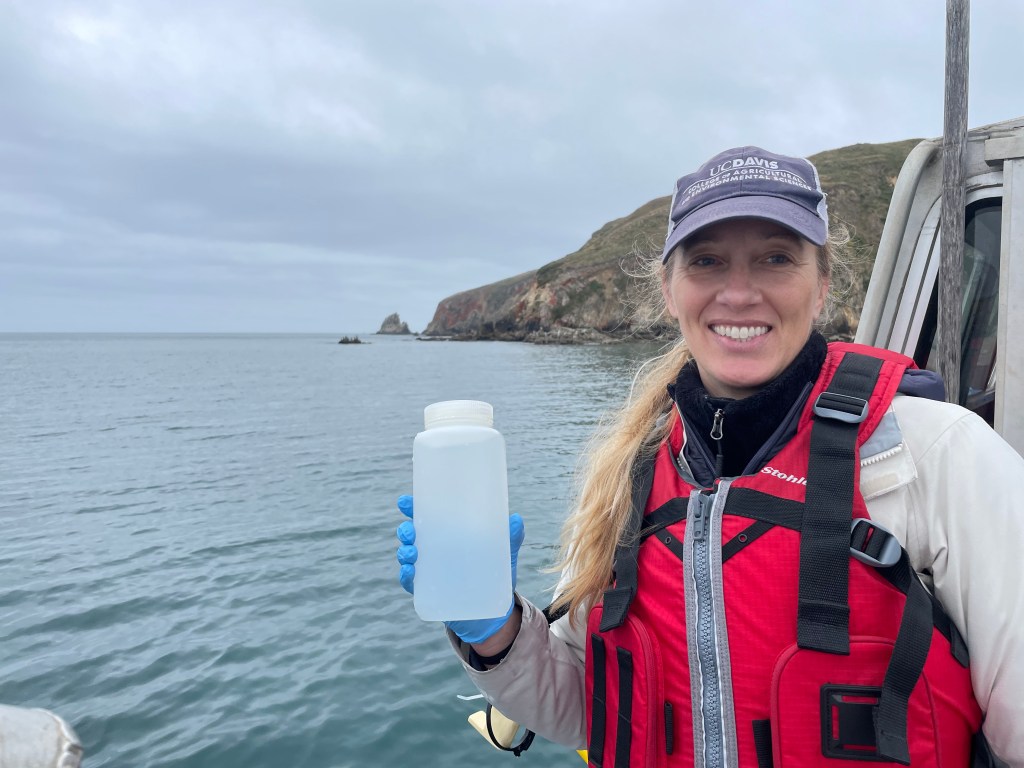
Led marine eDNA sampling, Point Reyes State Marine Reserve, CA (2023); obtained project funding, designed 1-day small-vessel sampling strategy, led field team, and developed Field Safety Plan approved by UC Davis Boating Safety
Led marine eDNA sampling, Bodega Head and Stewarts Point State Marine Reserves, CA (2020–2021); obtained funding for and designed eDNA sampling, and conducted 7 days of small-vessel sampling across 2 field seasons; led field team in collaboration with the community-based California Collaborative Fisheries Research Program; trained undergraduate researchers in eDNA sampling methods
Led guano sampling, Yolo Basin Wildlife Area and Putah Creek overpasses and bridges, CA (2019–2020); obtained funding and site access approval from CA Department of Fish and Wildlife and Putah Creek Riparian Reserve for 30+ sampling days; trained undergraduate researchers in guano sampling methods
Led stream eDNA sampling, Putah Creek, CA (2019–2021); co-designed seasonal sampling strategy, coordinated timing and site selection with electrofishing crews and trap monitoring teams for rotary screw and fyke traps; trained undergraduate researchers in eDNA sampling methods
Led canoe-based eDNA sampling, Suisun Marsh, CA (2019); designed and funded 3-day sampling effort; secured approval for field safety plan from UC Davis Boating Safety
eDNA and fish community sampling, Suisun Marsh Fish Study, CA (2019–2020); designed eDNA strategy and conducted monthly sampling for six months (planned 12-month effort reduced due to COVID-19); separately, conducted otter trawl and beach seine sampling, and identified and measured fish specimens
eDNA sampling, Enhanced Delta Smelt Monitoring survey and Delta Smelt Enclosure Study, San Francisco Estuary, CA (2017–2019); multi-year eDNA sampling from small vessels paired with Kodiak trawl surveys and enclosure monitoring for delta smelt conservation plan
Plankton sampling via net tows, San Francisco Estuary, CA (2013–2016); extensive sampling aboard small vessels as part of several estuarine research and monitoring projects
Backcountry electrofishing and genetic sampling, Paiute Trout Restoration Project, Silver King Creek, Alpine County, CA (2019); 5-day sampling expedition with CA Department of Fish and Wildlife and collaborators; remote, high-elevation conditions with pack mule support
Daily otter trawl sampling and eel grass surveys, Pacific Herring Research Project, CA Department of Fish and Game, San Francisco Bay, CA (2001–2002)
SELECTED FIELD & TECHNICAL TRAINING
Introduction to Passive Acoustic Monitoring, Dian Fossey Gorilla Fund, Kinigi, Rwanda (2023)
Occupancy Modeling & Metabarcoding Data Analysis Workshop, eDNA Technical Exchange Workshop, St. Petersburg, FL (2019)
Ecological Models and Data in R, Bamfield Marine Science Centre, BC, Canada (2018)
RADseq Workshop, California Academy of Sciences, San Francisco, CA (2016)
Coastal Ecogeomorphology Field Course, Geology 298, UC Davis (2018); 7-day sea kayaking expedition, Loreto National Marine Park, Mexico
Ecogeomorphology Field Course, Ecology 290, UC Davis (2018); 7-day self-supported rafting expedition, Colorado River, Grand Canyon, AZ
PROFESSIONAL AFFILIATIONS
American Fisheries Society, Global South Bats, Society for Conservation Biology

